
Why imperfect spaces feel more Alive
- adgrafics
- May 28
- 3 min read
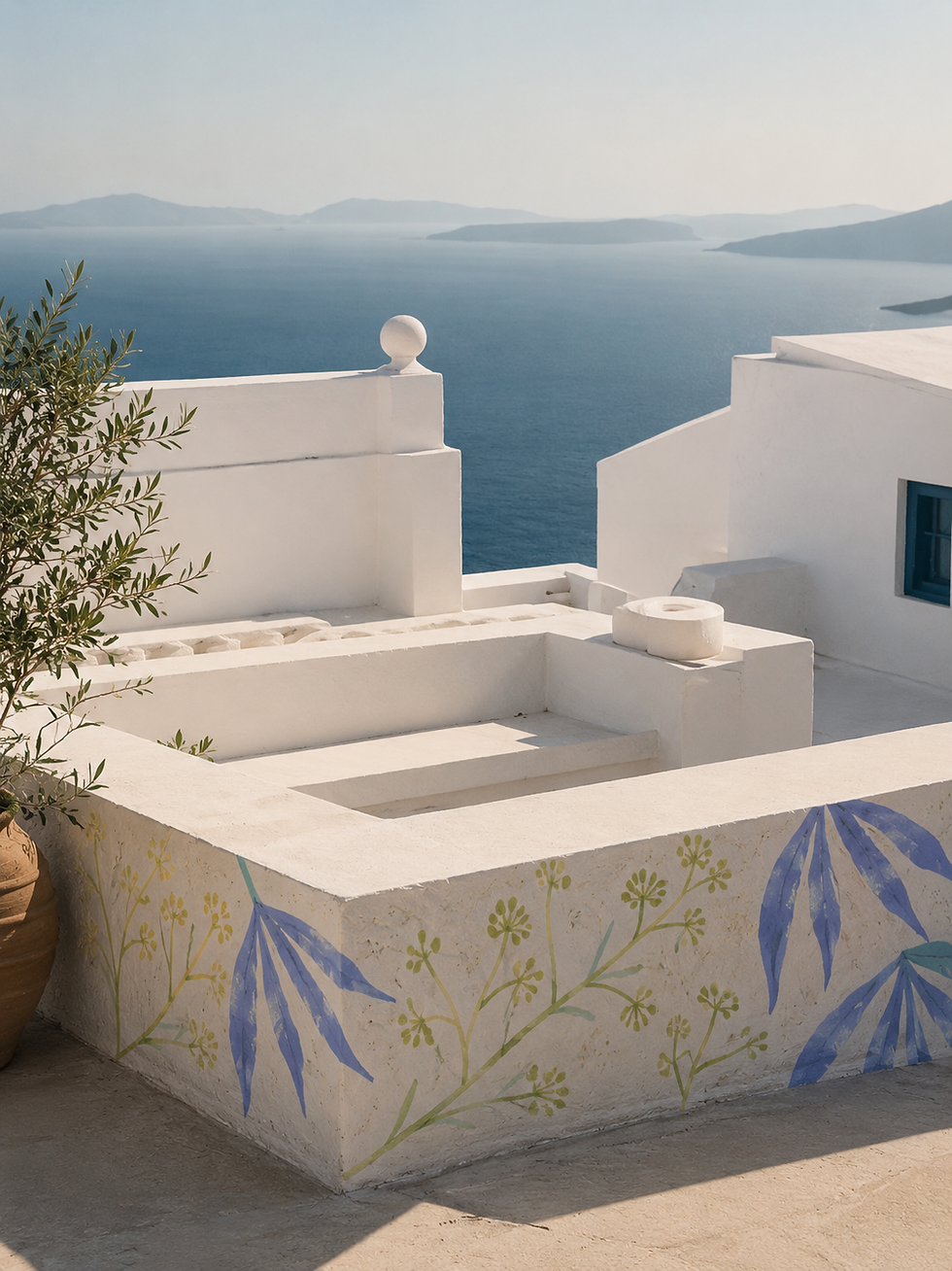
Some places are technically perfect.
And yet they leave us completely untouched.
Everything is aligned.
Everything is polished.
Everything is controlled.
And somehow, nothing breathes.
Then there are other places — slightly wild, weathered, asymmetrical, unfinished — that immediately feel alive.
A cracked terracotta pot overflowing with herbs.
An old stone staircase softened by moss.
A climbing jasmine escaping its structure.
A crooked wooden table under an olive tree.
Tall grasses bending differently every season.
Nothing is entirely “perfect”.
And yet everything feels deeply real.
The psychology of imperfection
Human beings do not emotionally connect to perfection as much as we think they do.
Psychologically, overly controlled environments can create subtle tension in the nervous system.
They communicate rigidity, performance, surveillance, even sterility.
Perfection often leaves no room for participation.
No room for surprise.
No room for life to happen.
Imperfect spaces, on the other hand, create psychological softness.
They allow the brain to relax because they mirror the organic reality of existence itself:
things grow unevenly,
materials age,
colours fade,
seasons transform everything,
and beauty constantly escapes fixed forms.
The nervous system tends to feel safer in environments that resemble nature rather than machines.
Nature is never symmetrical.
And yet nobody has ever looked at a wild meadow and thought it lacked harmony.
The hidden freedom of letting go
One of the paradoxes of gardens is this:
the more we try to control them completely, the less alive they become.
Mediterranean gardens especially teach this lesson beautifully.
A self-seeded flower appearing unexpectedly between stones.
A fig tree choosing its own direction.
Wild fennel arriving where nobody planted it.
These moments often become the soul of a garden.
Not the original plan.
There is a form of intelligence that only appears once control softens.
In gardening, as in life, letting go is not absence of care.
It is collaboration with unpredictability.
And strangely enough, this often creates more beauty than rigid perfection ever could.
Because surprise is part of emotional attachment.
We fall in love with spaces that continue to reveal themselves over time.
Black Box Gardening: allowing life to participate
This idea exists in what some call “Black Box Gardening”.
Instead of designing every detail with absolute control, the gardener creates conditions — soil, structure, atmosphere, biodiversity — and then allows nature itself to co-author the space.
The garden becomes less like an object and more like a conversation.
Plants move.
Species appear.
Unexpected combinations emerge.
The garden evolves beyond the ego of the designer.
And perhaps this is what makes certain gardens unforgettable:they were not entirely imposed.
They were allowed to become.
Imperfection creates authenticity
Today, much of the world has become visually homogenised.
The same polished interiors.
The same neutral palettes.
The same algorithmic aesthetics.
Everything becomes instantly consumable.
And instantly forgettable.
But charm often lives precisely in irregularity.
A wall marked by time.
An old iron gate that no longer closes perfectly.
Sunburnt shutters.
Handmade ceramics slightly uneven at the edges.
Mediterranean villages understand this intuitively.
Their beauty comes from accumulated life, not manufactured perfection.
Imperfection carries memory.
And memory creates emotional depth.
Gardens teach us resilience
A garden never truly obeys.
Drought comes.
Winds change.
Seeds travel.
Some plants die unexpectedly.
Others thrive where nobody imagined they would.
And still, the garden continues.
Perhaps this is why gardens can be such powerful emotional teachers.
They quietly remind us that beauty is not the absence of chaos.
Beauty is what emerges through coexistence with it.
A resilient garden is not flawless.
It is adaptive.
Alive.
And deeply authentic.
Perhaps charm is simply life that has not been over-controlled
The older I become, the less I trust spaces that feel too perfect.
They often leave no space for breathing.
No space for accidents.
No space for humanity.
The most beautiful places are often the ones where something escaped control:
vines overtaking stone walls,
wildflowers entering gravel paths,
light changing cracked surfaces,
nature reclaiming forgotten corners.
Because life itself is imperfect.
And perhaps we recognise ourselves more honestly in spaces that are allowed to be the same.
In a world increasingly obsessed with optimisation, sameness and perfection, imperfection may become one of the last remaining forms of poetry.
Not because it is careless.
But because it is alive.


Comments