
How to Turn Your Garden Into a Living Ecosystem

A practical guide to creating biodiversity, resilience, beauty and life at home
For many people, gardening begins with a simple question:
"What should I plant here?"
But nature asks a different question.
"What already lives here?"
A thriving ecosystem is not created by adding more plants. It emerges when water, soil, insects, birds, fungi, trees and humans begin supporting one another.
The good news is that you do not need a large property, a nature reserve or a huge budget to contribute to biodiversity.
Even a small garden can become a refuge, a corridor, a feeding station, a nesting site, a cooling island and a source of life.
This guide will help you transform your garden from a decorative space into a living ecosystem.
Step 1: Observe Before You Act
The most common mistake in landscaping is to start planting immediately.
Nature rewards observation.
Before changing anything, spend time understanding your site.
Observe:
Where the sun falls in summer and winter
Where water naturally accumulates
Where the wind enters
Which areas remain cool
Which areas dry out quickly
Existing trees and their influence
Birds, insects and wildlife already present
Spend several days or even weeks simply watching.
Nature often provides the best design brief.
Questions to ask:
Which places feel most comfortable?
Which places are unused?
Which places could become wildlife refuges?
What is already working well?
Step 2: Discover Who Lives There
Every garden already belongs to countless species.
The goal is not to impose a new ecosystem
but to strengthen the one that exists.
Research:
Local birds
Pollinators
Native bees
Butterflies
Hedgehogs
Lizards
Bats
Beneficial insects
Useful tools:
Local bird associations
Regional biodiversity databases
Nature conservation organizations
Look specifically for:
Species in decline
Species lacking nesting sites
Pollinators lacking food sources
Wildlife corridors that have been interrupted
The best ecological gardens respond to local needs.
Step 3: Water Is Life
Without water, biodiversity cannot thrive.
Even a small water source can dramatically increase wildlife activity.
Ideas include:
Bird Baths

Simple shallow basins with stones for safe access.
Keep water clean and refreshed.
Pollinator Water Stations
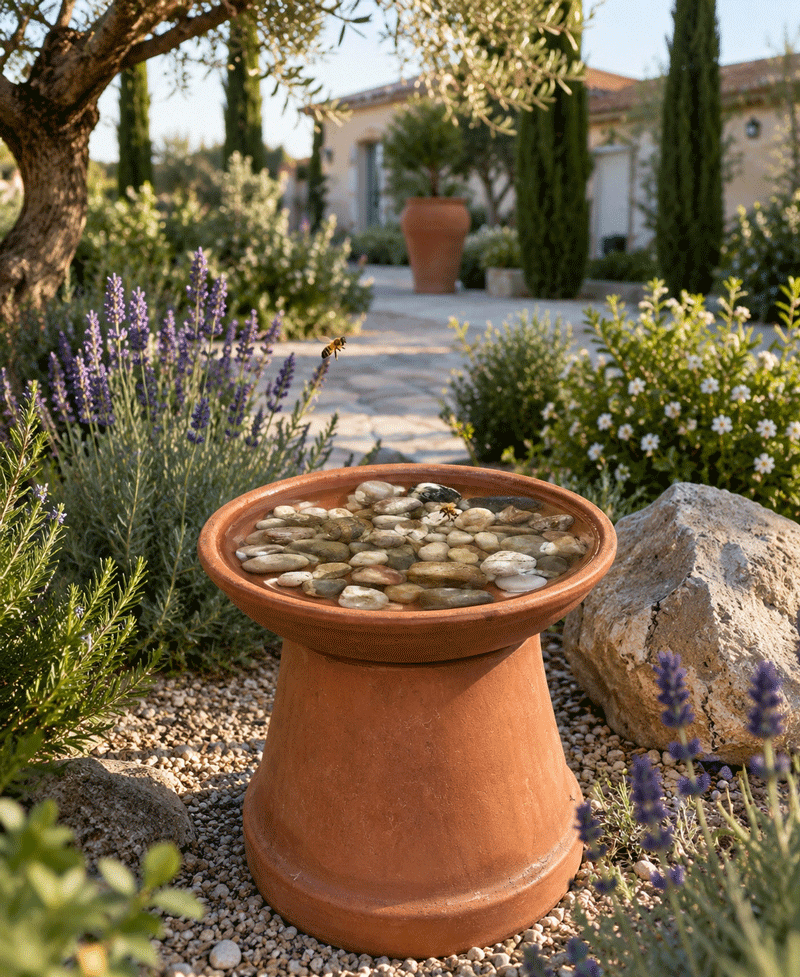
Place pebbles in shallow dishes to prevent insects from drowning.
Mini Ponds
Even a small pond can attract:
Dragonflies
Frogs
Birds
Beneficial insects
Rainwater Harvesting

Collect water from roofs and store it for dry periods.
Swales
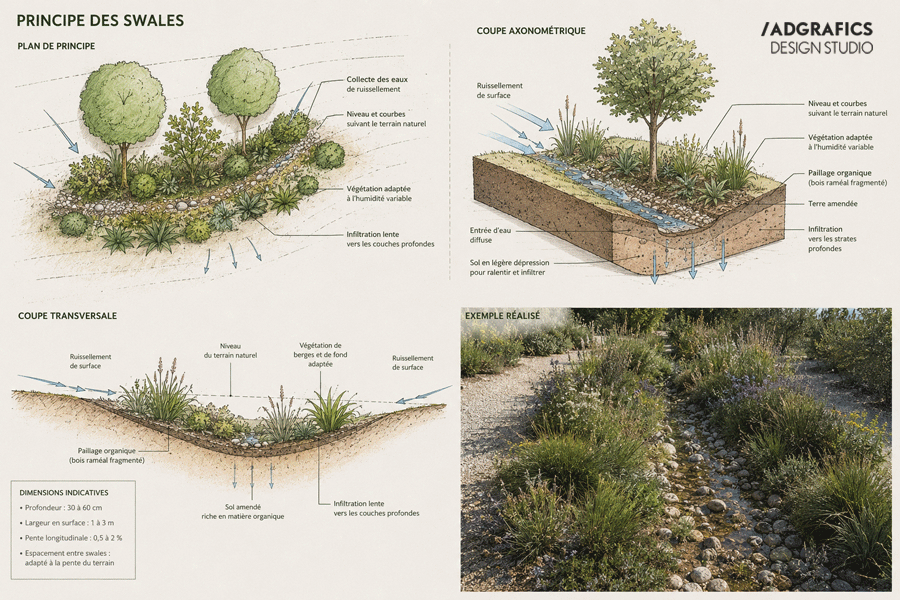
One of the most powerful tools for ecological gardening.
A swale is a shallow ditch dug along contour lines to slow down water, allowing it to infiltrate the soil rather than running away.
Benefits include:
Reduced erosion
Increased groundwater recharge
Improved drought resistance
Healthier plants
Greater biodiversity
Water is the foundation of every ecosystem.
Step 4: Create Shelter

Wildlife needs more than food.
It needs places to hide, rest, reproduce and survive.
Bird Nesting Boxes
Research which species are present locally.
Different birds require different entrance sizes and nesting conditions.
Hedgehog Shelters
Simple wooden shelters placed in quiet corners.
Leave access points through fences whenever possible.
Stone Piles
Excellent habitat for:
Lizards
Beneficial insects
Solitary bees
Dead Wood
A fallen branch can support hundreds of species.
Dead wood provides habitat for:
Beetles
Fungi
Mosses
Birds
Wild Corners
Leave certain areas unmanaged.
Nature often does its best work where humans intervene the least.
Step 5: Plant for Biodiversity
Many modern gardens contain beautiful plants but very little ecological value.
Instead of selecting plants only for appearance, think about ecological functions.
Ask:
Who will feed here?
Who will nest here?
Who will find shelter here?
Choose plants that provide:
Nectar
Pollen
Seeds
Berries
Cover
Habitat
Examples:
Pollinator-Friendly Plants
Salvia
Lavender
Verbena bonariensis
Echinacea
Nepeta
Thyme
Oregano
Bird-Friendly Plants
Hawthorn
Dog rose
Elder
Viburnum
Native grasses
Ground Cover
Ground covers protect:
Soil moisture
Soil life
Carbon storage
Bare soil should be minimized whenever possible.

Step 6: Use Every Layer of Space
A natural ecosystem uses vertical space.
Most gardens only use the ground layer.
Think in layers:
Canopy Layer
Large trees
Small Tree Layer
Fruit trees and ornamental trees
Shrub Layer
Native shrubs
Herbaceous Layer
Perennials and flowering plants
Ground Layer
Ground covers and self-seeding species
Root Layer
Deep-rooted plants improving soil structure
Every layer creates habitat.
Every layer increases resilience.

Step 7: Reduce Ecological Dead Zones

Ask yourself:
What percentage of my garden is actually alive?
Many gardens contain large areas of:
Lawn
Gravel
Empty paving
Decorative surfaces
These areas can gradually be transformed.
For example:
Replace:
10% lawn with wildflowers
10% paving with planting
Empty corners with habitat features
Small changes create large ecological gains.
Step 8: Create Wildlife Corridors

One garden alone cannot save biodiversity.
Connected gardens can.
Your garden can become a stepping stone within a larger network.
Ideas include:
Permeable Boundaries
Allow small animals to move freely.
Native Hedgerows
Provide food and shelter while connecting habitats.
Pollinator Routes
Ensure flowers are available throughout the seasons.
Tree Networks
Trees act as ecological highways for birds and insects.
A connected landscape is always stronger than isolated habitats.
Step 9: Plant Trees Whenever Possible

Trees are among the most powerful ecological tools available.
Their impact goes far beyond shade.
Trees:
Cool surrounding air
Store carbon
Improve soil
Capture rainwater
Reduce wind
Support birds
Feed pollinators
Increase biodiversity
A mature tree can lower surrounding temperatures by several degrees.
In a warming climate, trees are essential infrastructure.
Not decoration.
Infrastructure.
Step 10: Think Long-Term
Nature does not work on human timelines.
An ecosystem develops slowly.
The first year may look unfinished.
The third year begins to settle.
The fifth year starts functioning.
The tenth year becomes something truly alive.
Patience is one of the most ecological acts a gardener can practice.
Measuring Success
Success is not measured by perfection.
It is measured by life.
Look for:
More birds
More butterflies
More bees
More shade
More soil moisture
More biodiversity
More resilience
Most importantly:
Look for a garden that requires less control
and provides more abundance.

Final Thought
A garden becomes an ecosystem when we stop asking what we can take from it and start asking what life can find within it.
Every garden, no matter how small, has the potential to become a refuge.
A place where birds can rest.
Where pollinators can feed.
Where soil can heal.
Where water can stay.
Where people can reconnect with the living world.
And perhaps that is the future of gardening:
Not creating landscapes that dominate nature.
But creating places where nature feels welcome again.
Want us to support you into the creation of an ecological garden?
Contact us: https://www.adgrafics.eu/landscape-design
© Images are designed by AdGrafics Design Studio for educational purposes.


Comments