
Human Diversity Is the Engine of Evolution. Moral Judgement Is Stalling It—and Killing Creativity.
Updated: Sep 21
Stop Explaining People. Start Letting Them Exist.
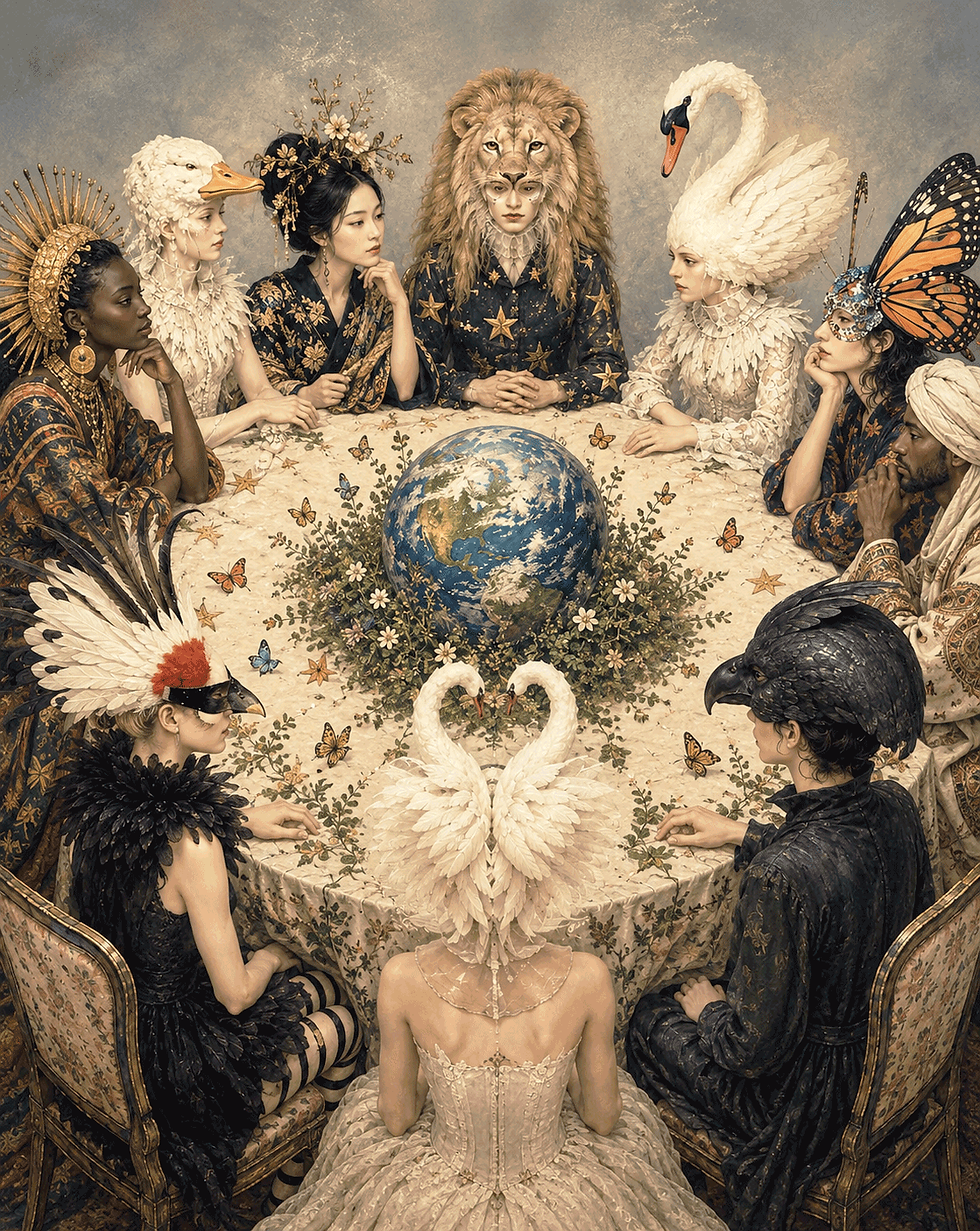
I believe we are living through a silent crisis.
Not a crisis of intelligence.
Not a crisis of talent.
A crisis of permission.
People no longer know how to live.
They no longer dare to be spontaneous.
They hesitate before speaking.
Before loving.
Before leaving.
Before beginning.
Before changing.
Before trying.
Not because they are weak.
But because every spontaneous impulse has become a social contract.
Every action must immediately be justified.
Every feeling explained.
Every difference diagnosed.
Every deviation categorized.
We have become a civilisation obsessed with explaining people instead of meeting them.
And I believe it is slowly killing creativity.
The Death of Spontaneity
Creativity is not born from certainty.
It never has been.
It is born from curiosity.
From wandering.
From taking a road that nobody understands yet.
From saying:
"I don't know why... but I feel drawn there."
Yet today, before following an intuition, people first ask themselves:
"What will people think?"
"What if they misunderstand me?"
"What if they think I'm unstable?"
"What if they think I'm selfish?"
"What if I regret it?"
Not because they fear reality.
They fear judgement.
And there is an enormous difference.
We Don't Let People Live.
We Explain Them.
Someone enjoys solitude.
"They're avoidant."
Someone wants children.
"They're following society."
Someone doesn't want children.
"They're selfish."
Someone falls in love easily.
"They're trying to fill a void."
Someone stays single.
"They're emotionally unavailable."
Someone changes careers.
"They're having an existential crisis."
Someone cries.
"They're too sensitive."
Someone doesn't cry.
"They're emotionally blocked."
Can we simply stop?
Can we allow people to exist without immediately turning them into a psychological theory?
We Have Mistaken Labels For Understanding
Social media has accelerated something subtle.
Everything now requires a name.
A diagnosis.
An identity.
A category.
ADHD.
Avoidant.
Empath.
Narcissist.
Highly sensitive.
Gifted.
Burned out.
Bipolar.
Introvert.
Extrovert.
Attachment styles.
Personality types.
Of course, many of these concepts are valuable.
Clinical diagnoses matter enormously for those who truly need them.
Language can bring relief.
It can help people understand themselves.
But somewhere along the way, we began confusing a description with an identity.
As though understanding someone meant reducing them to a word.
It doesn't.
Human beings are infinitely larger than the vocabulary available to describe them.
Do We Really Need To Understand Someone Before We Allow Them To Belong?
This question keeps returning to me.
Why do we need to understand someone before giving them a place?
Why do we need to define someone before accepting them?
Why do we need to explain them before loving them?
Could we simply say:
"I don't fully understand you... but I'm glad you exist."
Imagine the freedom inside those words.
No analysis.
No diagnosis.
No fixing.
Just presence.
Just curiosity.
Just two human beings meeting.
Perhaps belonging doesn't come from being understood.
Perhaps belonging comes from being welcomed.
Nature Never Asks Anything To Become Something Else
Walk into a Mediterranean landscape.
The olive tree survives drought.
The hydrangea would die there.
Move both into a rainy English garden.
Suddenly the hydrangea flourishes while the olive struggles.
Which one is the better plant?
Neither.
Their needs are different because their roles are different.
A forest survives because thousands of species coexist.
Some roots dive deep into the earth.
Others stay close to the surface.
Some trees grow quickly and disappear after a few decades.
Others grow slowly and live for centuries.
Some flowers attract bees.
Others bloom at night for moths.
Some plants fix nitrogen into the soil.
Others cannot survive without them.
If every species became an oak tree...
The forest would collapse.
Diversity is not decoration.
It is the operating system of life itself.
Nature evolves through difference.
Never through uniformity.
Only humans look at difference and ask:
"Which one is morally correct?"
Nature asks a far better question:
"What role does this one play?"
Perhaps we should too.
Every Human Is A Unique Ecological Function
Maybe we have misunderstood individuality.
We think uniqueness is about standing out.
I think uniqueness is about contribution.
Every person carries a way of seeing that nobody else possesses.
Every nervous system notices different things.
Every life experiences different wounds.
Different joys.
Different fears.
Different questions.
Those differences are not obstacles to belonging.
They are the very reason belonging exists.
If everyone became identical...
No one would bring anything new.
We wouldn't have a community.
We would have a production line.
People are not products.
People are ecological functions.
Each one performs something no one else can.
We Are Raising Adults Who Are Afraid To Experiment
Children naturally experiment.
They climb trees.
Invent games.
Pretend to be pirates.
Fail.
Laugh.
Try again.
Somewhere along the way adulthood teaches another lesson:
Don't embarrass yourself.
Don't change your mind.
Don't contradict yourself.
Don't fail publicly.
Don't disappoint expectations.
Be consistent.
Be correct.
Be explainable.
No wonder creativity disappears.
Creativity requires permission to look ridiculous.
What If Mistakes Don't Exist?
Here's a thought that keeps unsettling me.
What if many of the mistakes we fear are not mistakes at all?
What if they are simply experiences that later require adjustment?
Imagine touching a hot stove.
Was touching it immoral?
No.
You simply learned.
You adjusted.
Life works the same way.
Yet society often transforms adaptation into guilt.
The suffering doesn't always come from what happened.
It comes from everyone telling us what it should mean.
Maybe we wouldn't fear trying so much...
if failure weren't turned into a moral judgement.
An experience becomes shame only after someone declares:
"You shouldn't have."
Friends Should Hold Hands, Not Courtrooms
When someone we love gets lost...
Why is our first instinct to explain them?
To diagnose them?
To tell them what lesson they should learn?
What if friendship looked more like walking beside someone through uncertainty?
Holding their hand.
Saying:
"I don't know where this will lead either."
"But you don't have to walk alone."
That is how confidence grows.
Not because someone removes uncertainty.
But because someone stays while we navigate it.
Creativity Requires Psychological Safety
Every great discovery begins with uncertainty.
Every artist begins with a blank canvas.
Every entrepreneur with an impossible idea.
Every relationship with two strangers.
Every garden with bare soil.
Nothing beautiful arrives already proven.
Creation always begins where certainty ends.
Which means creativity requires one thing above all:
Psychological safety.
The freedom to try.
The freedom to change.
The freedom to say:
"Actually... this isn't me after all."
Without being sentenced for it.
We Don't Need More Moral Judges.
We Need Better Gardeners.
The people who changed my life were never those who constantly interpreted me.
They didn't try to fit me inside categories.
They didn't need me to make sense.
They simply noticed what was alive inside me.
And they watered it.
Gardeners never shout at a rose for attracting insects.
They simply plant lavender nearby.
They don't complain that an olive tree needs little water.
Or accuse the hydrangea of being needy.
They understand ecosystems.
Maybe humans should too.
The Future Depends On This
I honestly believe one of the greatest revolutions of the coming decades will not be technological.
It will be relational.
Learning to live with people we don't fully understand.
Learning to admire instead of classify.
To accompany instead of diagnose.
To become curious instead of morally superior.
Because every time we stop someone from being fully themselves...
We don't only lose that person.
We lose the idea they never dared to create.
The business they never dared to build.
The painting they never dared to paint.
The conversation they never dared to start.
The life they never dared to live.
Judgement doesn't simply wound people.
It impoverishes civilisation.
And perhaps the most radical act of love today is surprisingly simple.
To look at another human being and say:
"You don't need to make sense to me in order to deserve a place beside me."
Because creativity has never needed permission.
Only safety.
And maybe our role is not to become judges of one another...
But gardeners of one another's becoming.
What Happens When A Society Cannot Hold Difference?
History is full of artists, inventors, scientists and visionaries who spent much of their lives misunderstood.
Not because they were incapable of loving people.
Not because they wanted to be different.
But because they saw the world differently.
Many of them created in isolation.
Many struggled with loneliness.
Some suffered profoundly.
Of course, creativity itself does not create suffering.
But living in a world that constantly asks you to become someone else certainly can.
How many masterpieces were painted behind closed doors because their creators felt safer alone than misunderstood?
How many inventions arrived despite society rather than because of it?
How many extraordinary minds quietly disappeared because they became exhausted from defending who they were?
Those are the invisible losses we never count.
Today, We Are Losing Them Before They Even Begin
Social media has amplified something far more dangerous than criticism.
It has normalised permanent evaluation.
Every opinion receives a verdict.
Every behaviour a diagnosis.
Every difference an explanation.
Every life a comment section.
Perhaps the greatest tragedy is not that today's creators receive criticism.
It is that many never create in the first place.
Because they have already imagined the judgement waiting for them.
The painting stays inside the artist.
The book remains unwritten.
The company is never founded.
The idea never leaves the notebook.
The world doesn't lose finished masterpieces.
It loses the possibility that they might ever have existed.
If We Truly Want A Better Future...
We speak endlessly about innovation.
About sustainability.
About mental health.
About inclusion.
About equity.
About building a better society.
Yet none of these ambitions can flourish inside a culture of permanent judgement.
You cannot ask people to innovate while making failure shameful.
You cannot ask children to think differently while rewarding conformity.
You cannot ask artists to create while asking them first to become acceptable.
You cannot build a regenerative society with minds that are afraid to exist.
Perhaps the first ecological revolution is not about how we treat the planet.
Perhaps it begins with how we treat difference.
Because biodiversity allows forests to survive.
And human diversity allows civilisation to evolve.
Every time we protect someone's freedom to become fully themselves, we are not simply helping an individual.
We are protecting a future idea that only they could have brought into the world - and maybe could change the world.
That is why judgement is not merely unkind.
It is profoundly anti-evolution.


Comments