
From Abandoned Villa to Boutique Hotel: Where to Start?

There is a particular beauty in an abandoned place.
A faded wall.
An overgrown garden.
A staircase leading nowhere.
Old tiles half-hidden beneath dust.
A window opening onto a landscape that no one has contemplated for years.
When imagining the transformation of an abandoned villa into a boutique hotel, the first instinct is often to think about renovation: what needs to be repaired, replaced, painted or rebuilt.
But perhaps the first question should be different:
What does this place want to become?
Before designing, understand the place
Every abandoned building already carries an identity.
Its architecture, landscape, materials, proportions and imperfections tell us something about the people who lived there and the landscape in which it was built.
Rather than erasing these traces, a successful transformation can begin by identifying what deserves to remain.
An old stone wall may become the centrepiece of a room.
A forgotten terrace may become a garden for breakfast.
A damaged fresco might inspire the visual identity of the hotel.
An abandoned citrus orchard may become part of the guest experience.
The objective is not necessarily to restore everything to what it once was.
It is to create a dialogue between what was, what remains and what the place could become.
Visualising the transformation
Before architectural plans are finalised, visual exploration can help define the direction of a project.
This is where before-and-after renderings become particularly valuable.
Starting from photographs of the existing property, we can imagine different scenarios: the restoration of a courtyard, the transformation of an abandoned terrace, the atmosphere of a future room, the introduction of vegetation or the relationship between architecture and landscape.
Renderings allow an idea to become visible before major decisions are made.
Alongside them, moodboards help establish the emotional language of the future place: materials, colours, vegetation, textures, lighting, artworks and references.
Together, they begin to answer an essential question:
How should someone feel when they arrive here?
Beauty as a way of returning to the present


Hospitality is not only about providing somewhere to sleep.
The most memorable places alter our perception of time.
Beauty can make us stop.
We notice the texture of a wall, the movement of grasses in the wind, the shadow of a tree on stone, the smell of a garden after sunset.
For a moment, attention returns to the present.
In a world increasingly saturated with screens, speed and information, perhaps one of the greatest luxuries a place can offer is precisely this:
the possibility of being fully somewhere.
This is why aesthetic decisions should not simply follow trends.
They should contribute to the experience of the place.
Choosing materials that belong


Natural and noble materials have an extraordinary ability to connect architecture to its surroundings.
Stone, lime plaster, terracotta, wood, linen, ceramic, iron and other raw materials age rather than simply deteriorate.
Their irregularities become part of their beauty.
In an historic Mediterranean property especially, these materials can create continuity between the original building and its contemporary transformation.
Rather than making everything new, the intention can be to allow old and new to coexist.
A rough stone wall beside a contemporary piece of furniture.
Handmade ceramics against imperfect lime plaster.
Wild Mediterranean vegetation surrounding carefully restored architecture.
Contrast can be far more interesting than imitation.

Art as an invitation to contemplate
Art can also become part of the architecture of hospitality.
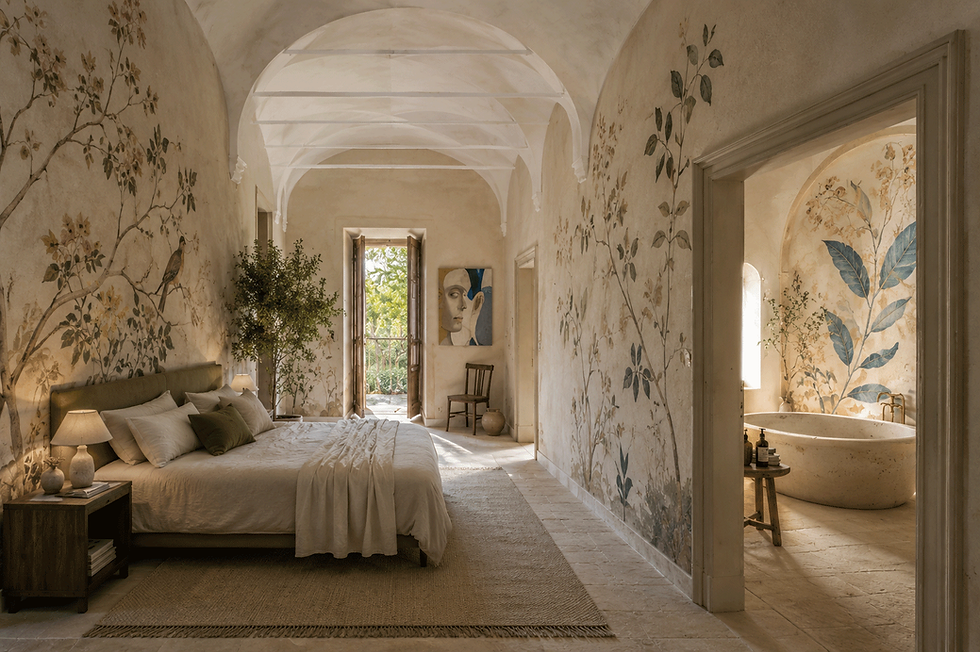
A mural does not necessarily need to be decorative.
It can create a pause.
A botanical illustration stretching unexpectedly across a wall, an imaginary landscape appearing inside a corridor, a fragment of local mythology hidden in a room...
These interventions can introduce something dreamlike into the experience.
Because travellers do not always want to find what they already know.
Sometimes they want to enter another world.
A boutique hotel has the possibility of creating precisely that sensation: a temporary universe with its own colours, scents, landscape and visual language.

Let the landscape participate
The transformation should not stop at the walls of the building.
Especially in Mediterranean properties, the landscape is part of the architecture.
An abandoned garden may contain existing trees, terraces, stone walls or forgotten paths that can become the structure of a new landscape.
Rather than creating a perfectly controlled garden, it can be more interesting to reveal what is already there and introduce Mediterranean planting that responds naturally to climate, soil and water availability.
The garden then becomes another chapter of the story.
A path through aromatic plants.
A hidden bench beneath an old olive tree.
A small courtyard filled with shadows.
A pool surrounded by grasses rather than an ornamental lawn.
The objective is not simply to make the exterior beautiful.
It is to create moments.


From history to storytelling
Once the physical and emotional identity of the place becomes clear, its story can extend into the brand.
The name of the hotel might emerge from its history, landscape or former inhabitants.
A symbol discovered in the architecture might inspire its logo.
The colours of an old fresco could become part of its visual identity.
Illustrations could reference plants found in the garden.
Menus, signage, stationery, room numbers and digital communication can all belong to the same universe.
This is where branding stops being something applied to a place afterwards. The place itself becomes the brand.
Its history informs its identity.
Its landscape informs its colours.
Its materials inform its visual language.
Its imperfections become part of its character.


From abandoned property to destination
Transforming an abandoned villa into a boutique hotel therefore requires more than imagining renovated rooms.
It requires imagining an experience.

Before beginning a complete architectural transformation, developing renderings, moodboards, landscape concepts, artistic interventions and an initial place identity can help reveal the potential of the property and establish a coherent creative direction.
At AdGrafics, we approach these projects at the intersection of place identity, landscape, art and visual communication.
Our Site Potential Studies help property owners, architects, investors and hospitality professionals explore what an existing or forgotten place could become — visually, emotionally and strategically.
Because sometimes the most extraordinary destinations do not need to be invented.
They are already there, waiting to be revealed.
Contact us


Comments